News
December 16. - 2025
Basal Metabolic Rate Shapes Thermoregulation in Cold-Stressed Mice
Basal metabolic rate (BMR) and body temperature are two fundamental physiological traits in mammals, both influencing energy balance and obesity risk. While these traits are evolutionarily connected, their relationship within species is still poorly understood. Many mammals can lower their metabolic rate and body temperature during harsh conditions like cold or food scarcity. This flexibility saves energy and aids survival in nature, but in laboratory animals and humans, it can complicate efforts to combat obesity by reducing energy expenditure.
Continuous core body temperature measured in mice
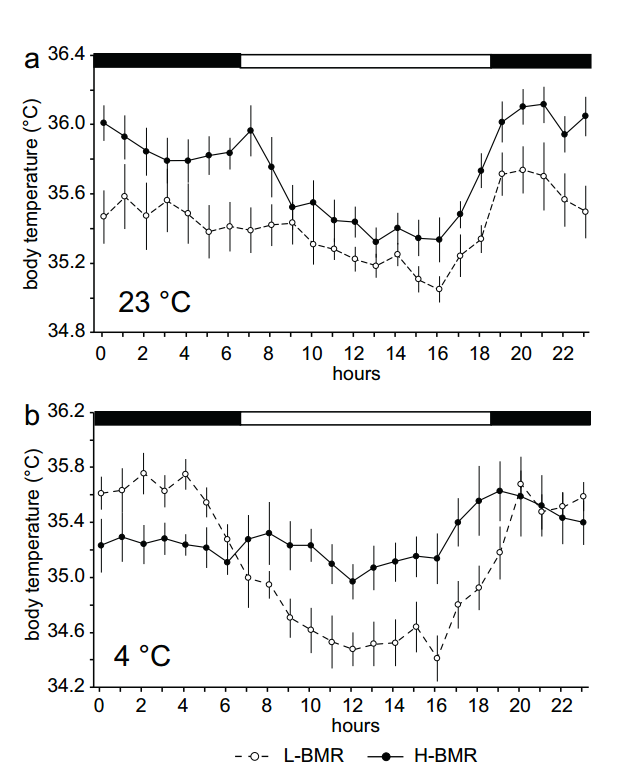
A recent study compared laboratory mice selectively bred for high or low BMR to investigate how variation in metabolic rate interacts with thermoregulation under different environmental conditions. Scientists from the University of Białystok, Poland, implanted 18 male mice, randomly chosen from each line, nine from low BMR (L-BMR) and nine from high BMR (H-BMR) with Star-Oddi’s DST nano-T temperature loggers. The loggers were implanted intra-peritoneally and set to measure core body temperature every 10 minutes for the length of the study. The mice were kept at ambient temperature of 23°C and then moved to 4°C to acclimatize for few weeks. The researchers then chose two 72h periods to quantify the body temperature of the mice (See fig. 1 below).

Fig. 1 shows the mean circadian body temperature pattern for the selected 72h, a) 23°C and b) 4°C used in the study.
H-BMR mice show higher TMEAN at 23°C and during night-time at 4°C
Mice with H-BMR maintained higher mean body temperatures at ambient temperature of 23°C compared to L-BMR mice, but this difference disappeared at ambient temperature of 4 °C due to a greater temperature drop in the H-BMR line during nighttime (active period). Both lines showed significant decreases in body temperature under cold acclimation, highlighting the interaction between metabolic rate and thermal flexibility.
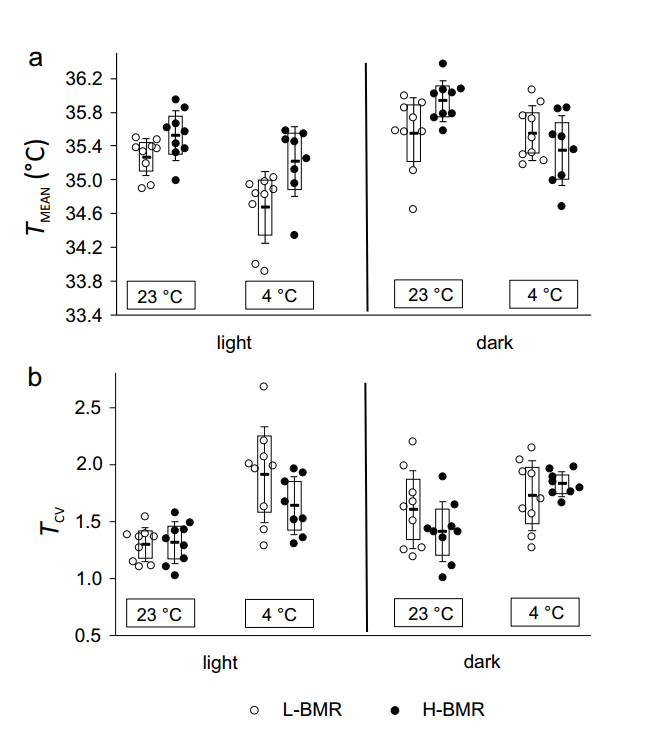
The impact of BMR selection on body temperature was more pronounced at night in cold-acclimated mice. While both lines showed similar daytime responses at 23°C, nighttime (active) temperature dropped significantly in H-BMR mice at 4°C but not in L-BMR mice, while L-BMR mice reduced the body temperature by more than a degree during daytime at 4°CThis indicates a line-specific differences in thermoregulation under cold stress.

Fig. 4 from the article showing the difference in body temperature during the dark and light phases of the day. Tmean top and the coefficient of variation of body temperature below TCV.
Account for BMR differences when studying body temperature
Artificial selection of BMR causes a 60% higher BMR in H-BMR male mice over their L-BMR counterpart. This resulted in a 0.32 °C body temperature difference at 23 °C, which disappeared at 4 °C and was lower than expected. This suggests that while BMR variation can influence body temperature and fat content, their relationship is flexible and context-dependent. Therefore, the authors’ conclusion is in a few words: BMR should always be considered in studies of body temperature and other physiological and metabolic traits like obesity.
Further results can be found in the article published in International Journal of Obesity and can be found here.
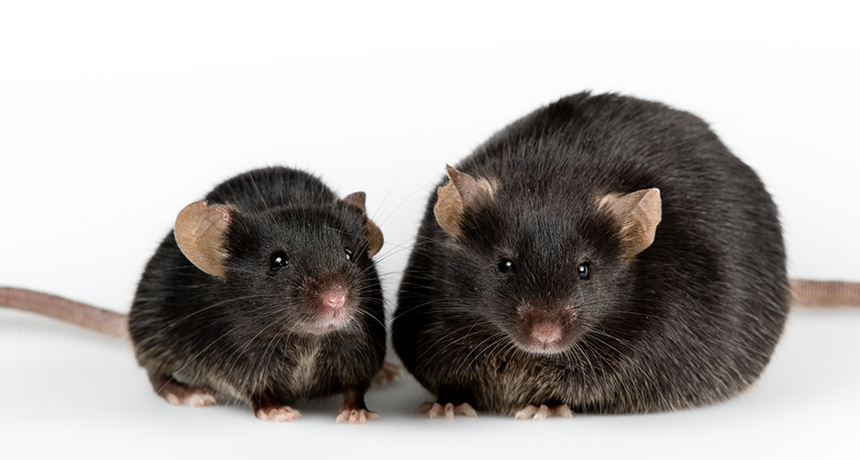
Photo borrowed from here.