News

December 4. - 2025
Four behavioural states of seabass defined based on level of heart rate and acceleration
Researchers at IMEDEA-CSIC in Spain and Wageningen University in the Netherlands recently published in Scientific Reports the paper: Biologging assessment of behavioural and physiological responses of European seabass (Dicentrarchus labrax) during stress challenges.
In their study, the team implanted 12 European seabass with Star-Oddi DST milli-HRT ACT biologgers and subjected them to swim tunnel and crowding test. They measured a range of parameters including cost of transport (COT), head width frequency (HWF), head width amplitude (HWA), tail beat frequency (TBF), oxygen consumption (MO2), heart rate (HR), acceleration (ACC) and QRS wave amplitude (AMP). The loggers recorded ECG signals at 200Hz for 7.5 seconds and the acceleration was recorded at 10Hz at set intervals.
Heart rate and acceleration: reliable proxies for energy expenditure
Both external acceleration and heart rate increased with rising flow speeds. Fish did not reach the critical swimming speed due to technical limitation; the maximum tested flow speed was 1m/s. A correlation matrix was calculated to show relationship between all measured parameters which many readers may find informative. The swimming stress test showed a strong positive correlation between oxygen consumption and acceleration (R2=0.76) and oxygen consumption and heart rate (R2=0.56).
Amplitude of the QRS waveform increases with crowding stress
QRS amplitude analyses were performed on ECG recordings using the free software HRT Analyzer from Star-Oddi during both the swim-tunnel and crowding trials. While the AMP did not increase significantly during the swim trial it did rise markedly during each of the crowding stress experiments. Indicating a relationship between stroke volume, heart rate, QRS waveform amplitude, and oxygen consumption. Further studies are needed to fully clarify these links.
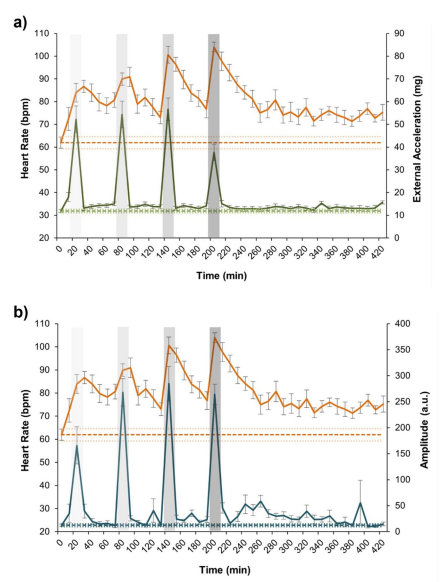
Fig. 5 from the paper showing heart rate (HR), acceleration (ACC), and amplitude of QRS wave (AMP) during the crowding stress challenge test.
A matrix of four welfare state described
Based on the swim tunnel trial and the crowding test, the authors defined four behavioural states for the European seabass based on a combination of low or high heart rate and acceleration: Reactive response, Proactive response, Resting state and Regular activity.

Fig. 7 from the paper. Behavioural states of European seabass based on data obtained by implanted biologgers on captive individuals.
This study demonstrates that biologgers are an effective method for detecting changes in behavioural patterns that indicate fish welfare in aquaculture. It further highlights heart rate as a reliable proxy for predicting stress in European seabass
The paper was published in Scientific Reports and can be accessed here