News
July 14. - 2026
First-Ever One-Year Heart Rate Recordings from Wild Polar Bears
Understanding energy expenditure in wildlife is essential for predicting how animals cope with rapid environmental change yet measuring it in the field remains a great challenge. New advances in implantable biologgers now allow long‑term monitoring of heart-rate (HR) and temperature, offering a powerful tool for studying species with extreme physiological adaptations. This is especially critical for polar bears, whose survival depends on energy intensive hunting on shrinking sea‑ice habitats. In a current study, Norwegian researcher tested subcutaneous heart‑rate & temperature loggers in wild polar bears (Ursus maritimus) in Svalbard, evaluating data quality and field protocols to determine whether these devices can reliably track energetic demands in a rapidly warming Arctic.
Implantable physio-loggers enabled high‑resolution HR and behavioural monitoring
Researchers from The Norwegian Polar Institute, The Arctic University of Norway, Kristiansand Dyrepark, Norway, implanted 5 wild adult female polar bears (Ursus maritimus) with Star-Oddi DST centi-HRT along with a GPS satellite collars. The loggers recorded heart rate every 15 minutes and stored 4‑s (standard) and 10‑s (long) ECGs twice daily. Raw ECGs were later manually validated using the Star‑Oddi HRT Analyzer. Loggers were implanted subcutaneously near the sternum under sterile surgical conditions. GPS collars provided location, activity, temperature, and time‑in‑water data, enabling behavioural context for HR quality assessments.
The heart‑rate monitoring revealed accurate HR ranges and high‑quality data
Adult female polar bears equipped with heart‑rate loggers showed consistently reliable heart rate (HR) data, with validated minimum HR ranging from 11–17 BPM and maximum HR between 125–178 BPM (see figure below), depending on the individual. Across more than 35,000–36,000 recorded HR measurements, the loggers delivered 100% data capture, and 82% of all HR readings fell within the best quality classes (QI 0–1). High‑quality HR data showed strong correlations with manually validated ECG signals, confirming the accuracy of the logger‑derived heart‑rate estimates. Although poor‑quality classes (QI 2–3) increased during denning months, manual validation still recovered usable HR values in up to 55% of these cases. These results highlight the reliability of long‑term polar bear heart‑rate monitoring, offering valuable insights into physiology, seasonal behavior, and energy use in Arctic environments.
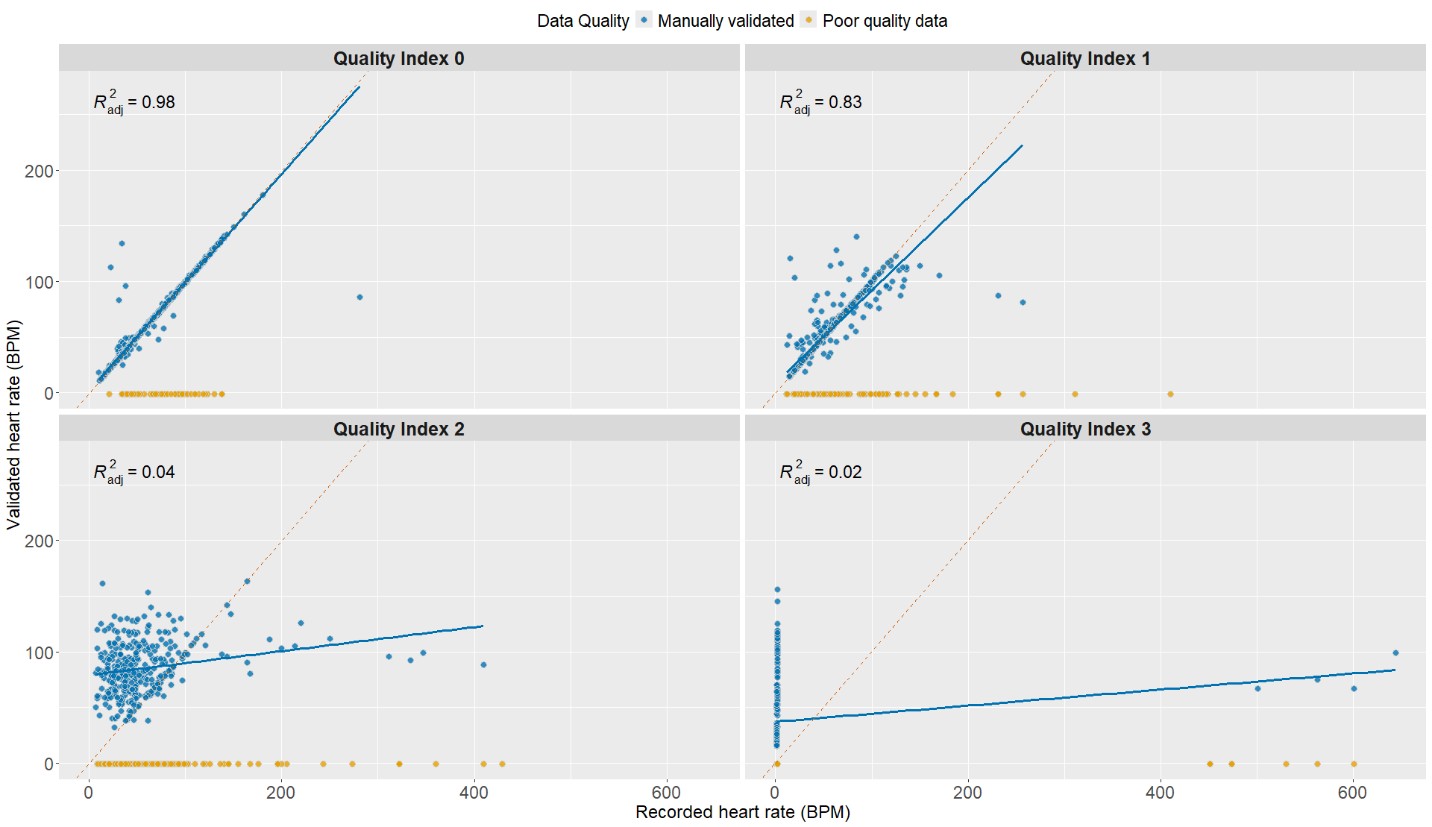
Correlation between the recorded HR by the loggers and manually
validated HR from raw ECG signals grouped by QI.
Further result can be found in the article publised in Animal Biotelemetry.