News
July 14. - 2026
Heart Rate, HRV and Temperature Recorded During the Broiler Grow-Out Period
Growing interest in science‑based animal welfare assessment is driving demand for tools that can reliably detect physiological changes linked to stress, health, and overall well‑being. Modern biotelemetry, especially continuous measures like heart rate, heart rate variability, and body temperature, offers a minimally invasive way to monitor welfare in real time, overcoming the limitations of traditional behavioral observations and stress‑inducing sampling methods. As research and regulatory expectations evolve, these technologies provide a powerful foundation for transparent, data‑driven welfare evaluation. This study aimed to test the feasibility and accuracy of implantable physiological loggers in broiler chickens and evaluate their ability to detect stress‑related changes. These objectives help determine whether continuous physiological monitoring can strengthen welfare assessment in both routine and experimentally challenged conditions.
Choosing implantation location
Belgian researchers from Ghent University, Paulpharm, ILVO, and Vetworks tested the feasibility of using implantable physio-loggers to study welfare in broiler chickens. First, they performed a pilot study with three chicks to determine the optimal location for implantation of Star-Oddi hear-rate loggers, using DST milli-HRT ACT. After determining that intracoelomic was the optimal location, the main study was performed with eight chicks, four in control group and 4 in test group. In the main study the birds were 7-41 day old Star-Oddi DST micro-HRT was used, which is smaller and lighter than the milli version. Heart rate and body temperature was measured at 500Hz every 30 min through out the day, with increased frequency of every 10 min from 7 am-1pm. Four ECG were saved every day, at every hour from 9am-12pm and actvity was only recorded in the pilot study.
Intracoelomic location of physio-loggers gives superior heart-rate data
The pilot trial showed that intracoelomic implantation produced far superior heart‑rate data, in terms of quality, than neck placement, and the neck‑implanted bird developed wound dehiscence, confirming the coelomic cavity as the safer and more reliable site for the main study. In the full trial, heart‑rate loggers delivered high‑quality recordings, with 80.2% of heart-rate (HR) samples classified as quality index (QI) 0 or excellent (see figure below), and over 14,000 validated HR measurements retained for analysis. HR declined predictably with age, while corticosteroid or CORT‑treated birds showed subtle, non‑significant reductions in HR. Temperature data (BT) revealed treatment‑by‑age interactions, and HRV metrics (SDNN, RMSSD) increased in weeks 3–4, though CORT had no overall effect. Together, the pilot and main study demonstrate that intracoelomic loggers provide reliable physiological data and can detect meaningful changes in HR, BT, and HRV under both baseline and experimentally induced stress conditions.
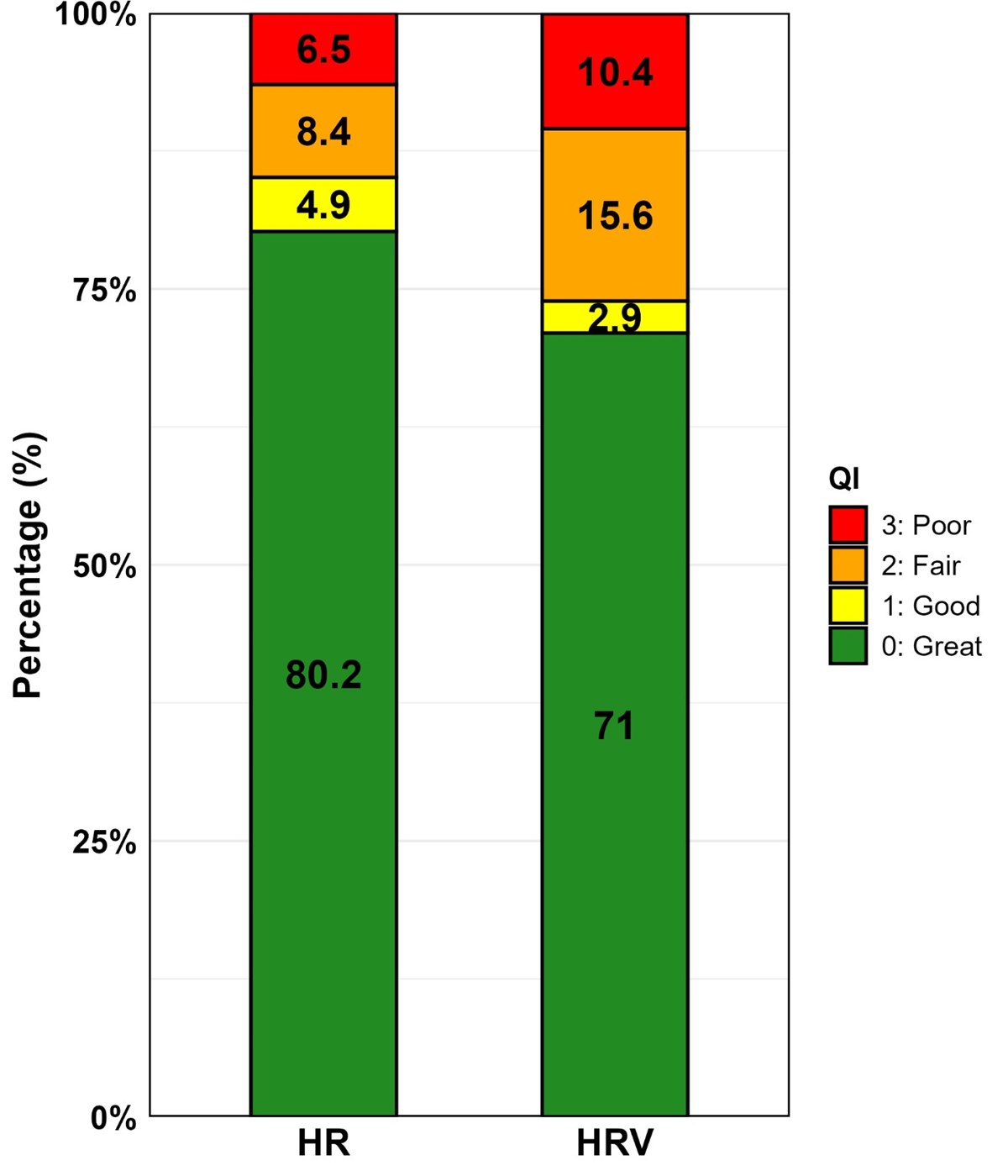
Percentage Quality index distribution of samples from all birds
for heart rate and heart rate variability measurements.
for heart rate and heart rate variability measurements.
Further results can be found in the article publised in Animal Biotelemetry.