News
January 29. - 2026
New Insights on Salmon Welfare: Bio-Loggers Track Stress, Growth, and Cage System Impacts
Norway is the world’s largest producer of farmed Atlantic salmon (Salmo salar), yet the aquaculture industry faces major sustainability challenges that limit future growth. Key issues include salmon lice (Lepeophtheirus salmonis) infestations affecting wild stocks, genetic risks from escaped farmed fish interbreeding, and eutrophication of fjords and coastal ecosystems. Despite technological advances, high mortality rates remain a pressing concern — in 2023, 63 million salmon (16.7%) died during the seawater growth phase, raising serious animal welfare questions. Emerging solutions such as semi-closed containment systems, offshore farms, and land-based recirculating aquaculture (RAS) offer potential pathways to reduce lice exposure, improve water quality, and enhance fish welfare. Continued innovation and rigorous testing of these technologies are critical for ensuring sustainable salmon aquaculture and maintaining Norway’s leadership in global seafood production.
Heart rate and activity measured with 6 hour intervals for 7 months
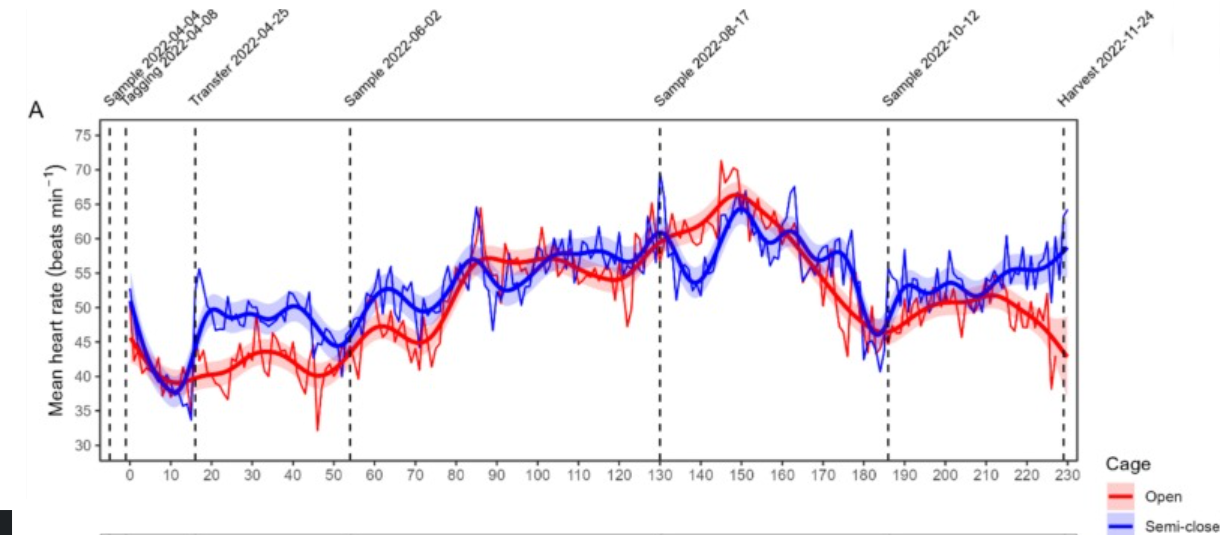
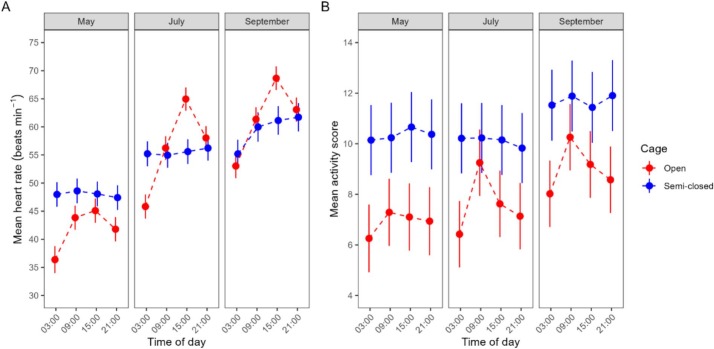
Scientist from Insitute of Marine Research, Norway, Deakin University, Australia, and University of Bergen, Norway, implanted two groups of atlantic salmon - 10 from a standard open sea cage, and 10 from a semi closed cage with - with Star-Oddi's DST milli-HRT ACT. The tags measured heart rate and acceleration with 6 hour intervals, or at 6 and 9 am, and at 3 and 9pm. The period of the study was about 7 months (April-November), during which a systematic sampling of 30 fish were made to assess size, welfare scorings and health indicators. The heart-rate declined nicely in the days after surgery, and stabilized gradually over two weeks post-surgery as show in fig. 5. The diurnal patter of heart rate and activity was more pronounced in the open cage with lowest heart rate just before dawn, and higest in the afternoon.
Fig. 5 A showing mean weekly heart rate, with daily means indicated by the jagged line.
Biologgers and Stress Physiology
Tag retrieval success was high (95%), with surgical wounds healing very well and no mortality directly linked to tagging, though tagged fish showed slightly reduced growth. Heart rate monitoring revealed recovery patterns post-surgery, diurnal rhythms, and correlations with activity (shown in fig. 6 from the article), weight, and temperature. Open cage fish displayed stronger daily heart rate variation, while semi-closed cage fish showed subdued rhythms. These findings highlight trade-offs in welfare and performance between cage systems, and the value of bio-logging for continuous stress and welfare assessment in aquaculture.
Fig. 6 showing diurnarl variation in heart rate (A) and activity (B) in the two systems.
Fish Welfare and Growth in Semi-Closed vs. Open Cages
Overall welfare scores were comparable between groups, though semi-closed cage fish showed higher frequencies of sores and fin erosion, largely linked to crowding and pumping during sampling. Growth performance initially favored the semi-closed cage, with faster weight gain and better condition early in the trial. However, severe crowding in August caused 16% mortality and reduced appetite, leading to slower growth and lower harvest weights compared to the open cage group. Maturation rates remained low in both systems (1.5–4%), with only males maturing. Mortality was initially higher in the open cage (3.5% vs. 0.4%), but later stabilized across both systems.
Further results can be viewed in the article published in Aquaculture.
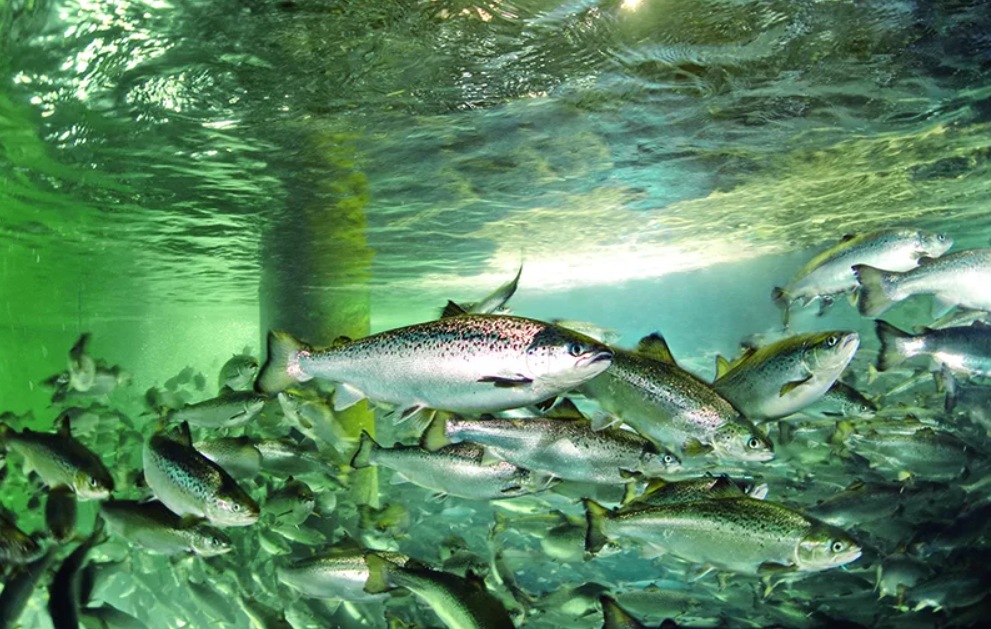
Photo borrowed from here.