News
October 9. - 2026
The Brain's Circadian Clock Plays a Central Role in Torpor Timing
Torpor is a natural energy-saving state that helps animals survive periods of cold weather, food scarcity, and other environmental challenges. During torpor, animals temporarily reduce their body temperature and metabolic rate to conserve energy. Although scientists have long known that the circadian clock influences when torpor occurs, the brain mechanisms controlling its timing have remained unclear. Using optogenetics the researchers were able to identify a key role for GABA signaling in the suprachiasmatic nucleus (SCN), the brain's master clock. This was done by activating GABAergic neurons in the SCN which inhibit the torpor-promoting pre-optic area (POA) neurons.
Temperature data combined with neural circuit manipulation
Scientists from Nagoya University, Meiji University, Kanazawa University, and National Institute for Physiological Sciences and the Chinese Institute for Brain Research (CIBR) used Star-Oddi's DST nano-T temperature loggers to continuously monitor core body temperature in female mice. The miniature loggers were implanted in the abdominal cavity and recorded temperature every five minutes throughout the study. This allowed researchers to accurately identify torpor episodes and measure changes in thermoregulation during fasting, cold exposure, and neural circuit manipulations. In some animals, DST nano-T data were combined with recordings of brain activity from the SCN, enabling simultaneous measurement of body temperature and circadian neural activity.
The brain circadian clock plays a central role in torpor regulation
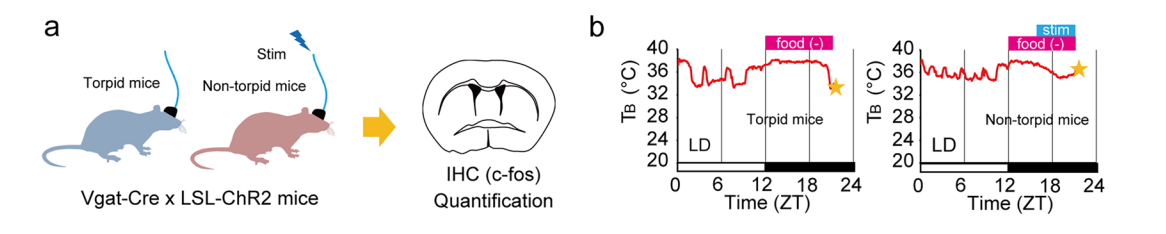
The nano-T recordings revealed that healthy mice consistently entered torpor during a specific window from late night to early morning, demonstrating that torpor follows a circadian pattern. In contrast, mice with disrupted circadian clocks showed abnormal torpor timing, with body temperature drops occurring throughout the day and night. The data also showed that activating neurons in the SCN prevented the normal decline in body temperature associated with torpor, while disruption of SCN signaling altered or abolished normal torpor patterns (se fig. below). Together, these findings provide compelling evidence that the brain's circadian clock plays a central role in determining when animals enter torpor, helping coordinate energy conservation and survival during challenging environmental conditions.

From figure 3 in the article A) showing the SCN stimulation devices and B) showing the temperature data with and without stimulation of the SCN.
You can find further result in the article published in Nature Communications.