News
April 9. - 2026
Small CTD Used to Map Salinity in Benthic Research
Scientists can keep an eye on the condition of marine ecosystems by conducting benthic research. In a recent study they made seasonal maps to monitor seasonal changes in the benthic fauna in Holyrood bay, Canada. Changes in water temperature, salinity, sedimentation, and human disturbance, for example, cause the Sub-Arctic species to react. These alterations serve as potent markers of the ecosystem's health. Because benthic assemblages respond significantly to temporal and spatial environmental variability, seasonality is a crucial but occasionally disregarded aspect in studies of seabed ecosystems. Significant seasonal fluctuations in temperature, salinity, light regimes, and organic matter availability influence the physiological performance and behavioural strategies of benthic taxa in Sub-Arctic settings. These dynamics result in predictable yet complex patterns in trophic interactions, functional traits, and community composition. In spite of this, the majority of maps of benthic communities remain static representations that overlook biologically significant temporal variation.
Salinity measured using Star-Oddi small CTD sensor
Scientists from Memorial University of Newfoundland and Labrador and Fisheries and Oceans Canada measured temperature, conductivity, and salinity at 52 sites using a Star Oddi DST CTD. They collected data for 2 min drifts at each site with a 2 second interval. Mean drift values were assigned to each midpoint location.
Spatially continuous environmental surfaces were generated in ArcGIS Pro using Empirical Bayesian Kriging Regression Prediction with bathymetry as the explanatory variable and a smoothed circular neighbourhood (smoothing factor 0.2).
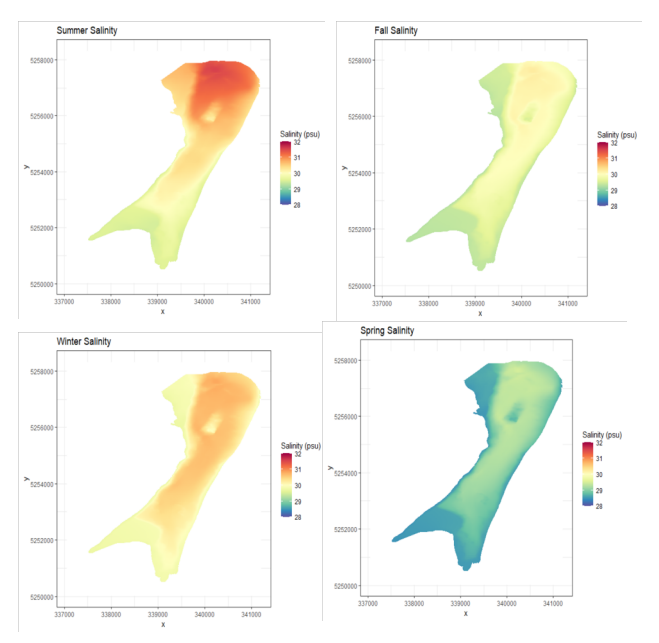
Fig. S24 shows predicted maps salinity (psu) across seasons in Holyrood Bay, from July 2020-April 2021.
Seasonal combination of benthic species observed
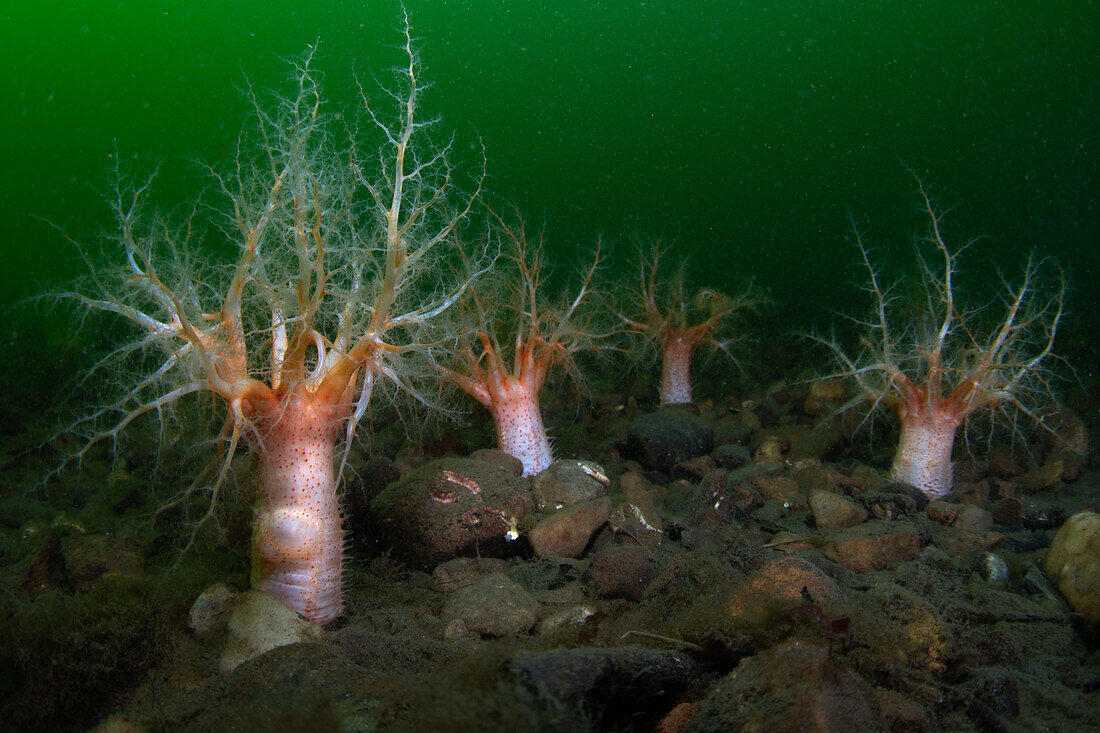
A total of 61 morphotaxa were recorded in Holyrood Bay, with seasonal species‑accumulation curves reaching asymptote. Species richness peaked in spring (50 morphotaxa) and was lowest in summer (43), while overall species density was highest in summer and lowest in winter. The fuzzy sea cucumber Psolus cf. phantapus was the most frequently observed taxon, though at reduced densities in fall and winter. Anthropogenic debris was also common, averaging 14 ± 18.96 items per season, including bottles, cans, rope, a tire, and a plastic bag.
Further results can be read in the article published in Marine Ecology Progress Series.
Photo of fuzzy cucumber.